
Olga FitzRoy – Recording Engineer
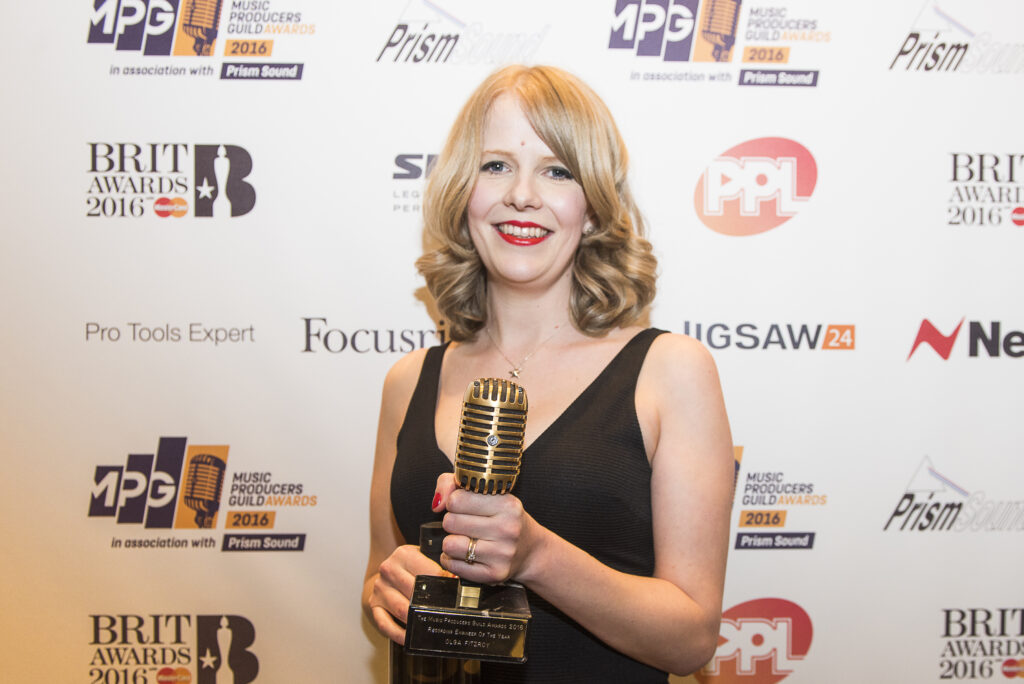
Name Olga FitzRoy
Title: Recording Engineer / Mixer
Company or Organization: formerly AIR Studios, now freelance and managed by AIR Management
Artists or projects worked with: Coldplay, London 2012 Olympics, composer Stephen Warbeck, The Hobbit trilogy
Link olgafitzroy.com
FEMMUSIC: How did you get started in studio production?
OF: After completing a week of work experience working with sound and lighting technicians in a theatre aged 15, I decided that being a sound engineer would be a good backup plan to being a drummer in a band. I soon decided to make this my plan A, and left school at 17 to do a college course in music and audio production in Glasgow. At the end of this course I was no closer to getting a job in a studio, so then I applied to the Tonmeister course at Surrey University, which includes a year in industry, which at the time included placements at AIR and Abbey Road. I got the AIR placement, and was offered a permanent job while I was still on my industrial year, which I then took up upon graduating.
FEMMUSIC: What are the biggest lessons you’ve learned doing your job? What do you wish you knew before you started?
OF: I’ve learned so much – I don’t think there’s anything in particular I would have liked to know from the off – nobody likes a smartarse, and as long as you’re keen to learn and willing to listen, most people are more than willing to teach you stuff as you go along. A few important lessons I’ve picked up along the way would be…”Don’t present anything you don’t think is as good as you can make it” – even if you’re doing a rough mix, or are unsure whether you’re going in the right direction with a comp or a mix or an edit, get it so you’re happy with it before you play it to people to get their input. Another piece of excellent advice, which I think I was given by a lecturer before I even started my placement was, “Be nice to everyone – from the MD down to the cleaner” this probably applies to most jobs.
FEMMUSIC: What do you look for in a project?
OF: Good music and a team of people I enjoy working with.
FEMMUSIC: What project are you most proud of & why?
OF: I’m proud of so many things I’ve worked on for many different reasons. I’m proud of mixing a lot of the closing music for the 2012 Olympics as it is probably the gig with the biggest viewing / listening audience I’ve done (estimated viewing worldwide was 750 million) (https://en.wikipedia.org/wiki/2012_Summer_Olympics_closing_ceremony), and we all worked incredibly hard on that one, including a couple of all-nighters. I’m also very proud of the Live at AIR Studios EP that I recorded and mixed for the band Daughter, as there were the challenges of recording a band and orchestra live, with monitor wedges and a film-crew, and we ended up getting a really beautiful result. I was also very chuffed when the Coldplay Ghost Stories live concert film won Best Music Programme at the Broadcast Awards last year, as I’d worked very hard with producer Rik Simpson on that, even spec’ing and building a custom 5.1 system at the bands own studios.
FEMMUSIC: What challenges do you see for women in studio production?
OF: As a mother to a one-year-old I’ve found organizing childcare to cover the irregular hours of studio work to be a bit of a learning curve (you need lots of backup plans!), but I personally see this as a challenge for anyone doing those hours and who has children, not just women. There is no excuse in this day and age for men not getting involved in childcare, although the government still needs to do more to level the playing field in this area. For example, Shared Parental Leave (SPL) is not applicable to freelancers (most engineers & producers), forcing self-employed women to take all their Statutory Maternity Allowance in one block, without the option to dip in and out of work in that first year. Not ideal for people who work on a gig-by-gig basis, and is classic example of a policy designed to make good headlines without it having been thought through. The fact that SPL only had an uptake of 1% means that more needs to change. https://www.theguardian.com/money/2016/apr/05/shared-parental-leave-slow-take-up-fathers-paternity
FEMMUSIC: What mentors did you have when learning?
OF: I assisted a lot of different people in my time at AIR, but I probably worked most with two of the most senior engineers there, Geoff Foster and Nick Wollage, and learned a lot from both.
FEMMUSIC: Are women in studio production treated differently than men? How do you see this?
OF: I don’t think that I’ve been treated particularly differently to my male colleagues – On a few occasions a (male) producer or artist has expressed that it is a good thing to have a female member of the production team, just to have a more gender-balanced control room, and on some occasions I’ve felt that being a woman has helped to build up a rapport with a female artist who might be a bit fed-up of working in a completely male-dominated environment. Equally, there may be some male and female artists who prefer to work with men, but I personally haven’t been aware of this.
FEMMUSIC: What advice do you give to women wanting to go into studio work?
OF: Be ready to do long hours, for not necessarily very much money, for a long time.
FEMMUSIC: What one thing would you change about the music industry?
OF: I think the use of free or below-minimum-wage labour in studios has got worse since I started (I was paid a runners wage for my placement year), and this is excluding a whole pool of talented people who don’t happen to have rich parents. I think more needs to be done by studios, producers and record-labels to crack down on this. If someone is doing a proper job that is benefiting a project or an individual then they should be paid for it.