
Dead Gowns – Vegas
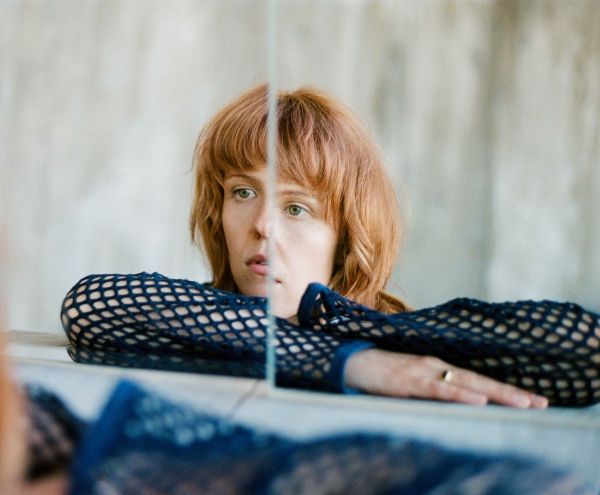
Portland, Maine’s Dead Gowns announce new album, Vegas, arriving October 23 on Mtn Laurel Recording Co.

Lead single “Vegas Dream” introduces the emotional landscape of Dead Gowns’ forthcoming album Vegas, the second full-length with Mtn Laurel. Written by Geneviève Beaudoin, the track explores distance, avoidance, and the ache of losing someone who once felt essential. With soaring guitars, atmospheric synths, and a powerful vocal performance, “Vegas Dream” opens the door to Dead Gowns’ most vulnerable work yet.
Part one of a four-segment series, the music video for “Vegas Dream” reveals GV trapped in a car, piled high with the remnants of a move and a road trip. Behind her, flashing neon. The Las Vegas strip? No, GV is moving through a seemingly endless car wash- singing in the driver’s seat and in the back. Unable to settle, she’s not always in control. At the end, as crystal-clear water beads are sucked off the windshield, we sense a new beginning as GV drives off to her next destination.
Video Director Emilie Silvestri says about the video: “While [the song] “Vegas Dream” is the story of a road trip, to me it also felt a lot like being stuck – in a car, in a loop, with your thoughts. The car wash felt like the perfect place to film this song, the colors and lights cycling through various hues and moods and the suds and water trying to wash it all away.”
Remembering it over and over again: the way it happened in Vegas, the way beginnings spill over onto endings. Geneviève Beaudoin, the Portland, Maine-based songwriter, went to Las Vegas in the summer of 2021 to help a close friend move and start a new life there. But buried within that newness, there was an old and gradually widening fracture—and in that city, the friendship ended.
On a certain level, we anticipate strain and rupture in a romantic context. But we don’t as easily expect or extend that same kind of awareness to close friendships, which cut just as deep, and hold up just as much of our sense of belonging and mattering. Feeling raw and unraveled, Beaudoin realized these were songs she needed to hear, as much as she needed to write. Back home in Maine, she began crafting her second full-length album as Dead Gowns.
Recorded in a farmhouse at the foot of the White Mountains with Beaudoin’s long-time partner Luke Kalloch, and produced by Sam Kassirer and Colin Lester Fleming, Vegas is a series of raw, smoldering songs that suddenly gape. It is an album that watches grief move, point by point. Every track blurs place and time, as memory and self, seed and fruit, “hardcore and wellness” become refracted and indissoluble.
We find ourselves, with the opening track, “Everything You Wanted,” stranded in a brooding portrait of anxious, overwrought intimacy. “It’s not like it was / But it’s not like it wasn’t,” Beaudoin equivocates, her voice cloaked. The chorus, which shifts the song down rather than up, is a baneful refrain of the title: “I wanna give you, give you / Everything you wanted,” Beaudoin chants, slow, deliberate, enormously lonely.
“Vegas Dream” opens up the terrain, from cave to cavern—and her voice along with it, even as Beaudoin sings largely about avoidance, about traveling all over the map and yet not knowing how to confront the person she misses most. It’s an emotionally harsh song, especially when Beaudoin declares herself a coward for not confronting the tension head-on. “My head was buried in the ground,” she confesses. “Sometimes you bury deep / Just to hide the sound / The —” and here the song performs as much as describes this repression by reducing the chorus to a percussive, wordless incantation.
“Vegas Dream” also introduces us to the aural lexicon of this record: bold guitars (Kalloch, Beaudoin) and synths (Kassirer)—not quite abrasive, but not quite warm, either—yawning drums (Flemming), and feathery piano (Kassirer). It’s all bright lights and dark water, every instrument a response to the ache of Beaudoin’s voice, a voice which increasingly anchors the album as it unfurls.
There is no clean resolution to Beaudoin’s lingering questions. “Is it hardcore or wellness?” she enjoins, over and over again, on the song of the same name. Walking through her small New England town, healing and pain seem difficult to disassociate. “Think I’m losing my compass,” she admits. Like a rushing and retreating wave, all these binaries seem to dissolve into one motion.
After all this unmooring, all this sometimes-gentle, sometimes-ruthless self-examination, “New Blue,” the first song on Side B, wants to wake us up from the “Vegas Dream.” One of a number of stately, spare tracks grounded in Kassirer’s piano, “New Blue,” is a song about choosing to stay in place for a change—a song that looks to move on, instead of just moving. Even an old sky, the song muses, carries a new blue every morning. “I’m gonna do it over,” Beaudoin resolves. “Are you coming, too?”
We see that boldness and tenderness rearticulated in the album’s final two songs: “No Longer Contacted,” a strident indie-rock love song to Beaudoin’s partner, and “Fruit,” a show-stopping dirge about resilience in the very heart of the pain. Both songs feel like a product of erosion, like stones worn smooth by sea water. In the end, despite its title, Vegas is an album that really belongs to the wild Maine coast, Beaudoin’s home: wistful and corrosive, giving and taking, strangely graceful. “We’re in the waves now, love is an ocean,” she concludes on “No Longer Contacted.” Love is that encompassing: you think you’re past it, but you’ve hardly started with it.
Where do those waves leave us? Maybe with an understanding of what’s really at stake. Beaudoin may not be able to bring back that one friend, to call them up again, but the project of Vegas has left her choosing to show up differently now. If there’s a “compass” to be recovered, this is it: the resolve to hold on to the people we love, to bring about a more courageous and vulnerable form of care in the relationships we keep.
#voila_deadgowns