
Julie Kathryn – Producer
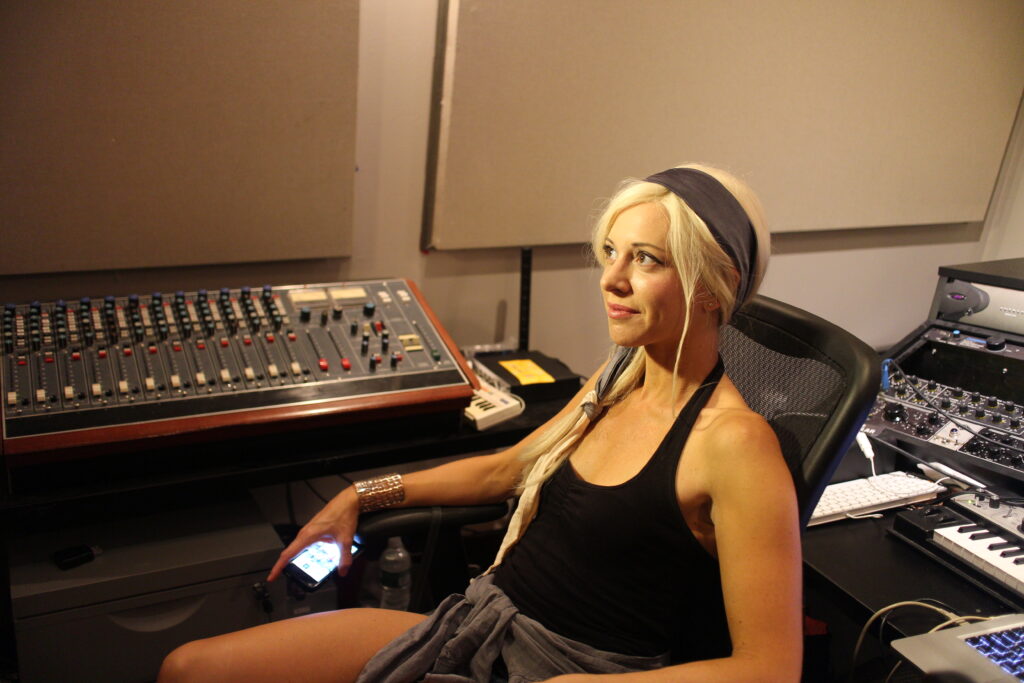
Name: Julie Kathryn (aka I AM SNOW ANGEL)
Title: Producer/Artist
Company or Organization: Female Frequency, I SNOW ANGEL
Artists or projects worked with: I AM SNOW ANGEL, Dani Mari, Claire London, Madame Gandhi, Amalia Watty, PJ O Connor, Celeste Krishna
Link: iamsnowangel.com
FEMMUSIC: How did you get started in studio production?
JK: As a singer-songwriter, I had been working with other producers for a few years. I didn’t feel entirely connected to the music I was creating. It never turned out the way I had conceptualized it, and I struggled to communicate my ideas. Eventually, I played around in Garageband and made some of my own demos. I immediately felt more connected and satisfied with the sound I was creating. From there, I learned how to use Logic Pro and Ableton Live. I’ve been obsessed with audio production ever since!
FEMMUSIC: How did you come to Female Frequency?
JK: In 2015, I met Dani Mari. She was looking for a female producer and struggling to find one. At our first meeting, we conceived of the idea of creating an entirely female-generated EP, from composition and performance through production, mixing, mastering and visual media. Claire London joined the project, and we named it Female Frequency. The three of us immediately began creating our album. We collaborated with some really amazing women on the project, including Madhame Gandhi, Kimberly Thompson, Jett Galindo, Dara Hirsch, Kerry Pompeo, Ryat, and Maria Rice. We also set up an online community for women in audio production, with the goal of encouraging women to explore engineering and production. We continue to periodically offer workshops and events for women in music.
FEMMUSIC: How do you approach producing someone else’s material vs your own?
JK: My approach is dictated by how involved the artist would like to be in the production process. If an artist asks me to create a track, and she just wants to write a melody and lyrics, then I use the same process I do for creating my own material – I create an instrumental track, and then we record vocals. If the artist would like to be more involved as a co-producer, then we create a rough demo with scratch vocals. After that, we create the instrumental landscape together (using our demo as a guide), and then we re-record the vocals
.
FEMMUSIC: What challenges do you see for women in studio production?
JK: A lack of visible role models can be a challenge for women in audio production. When I was younger, I didn’t know any women who were producing music, so I didn’t realize that I could do it. Fortunately, more women are now becoming prominent in the field. Some wonderful organizations – including female:pressure, Women’s Audio Mission and WOMANPRODUCER – have made a lot of progress in raising the visibility of women in audio and empowering women and girls to become producers. I feel optimistic that this trend will continue!
Another challenge can be the male-dominated studio environment, in which women are traditionally top-liners and singers, but not typically involved in the production process. As a result, studio settings can sometimes feel unwelcoming for women. Again, I’m optimistic that the landscape is shifting and becoming more equitable as more women become producers and engineers.
FEMMUSIC: What mentors did you have when learning?
JK: Erin Barra has been a really important mentor for me. She is now a professor at Berklee School of Music. She’s the also the creator of Beats By Girlz. She’s been a trailblazer for women in production – especially in the world of Ableton Live. She taught me how to use Ableton and put together my live set, and she continues to be a valuable resource for me. Tony Conniff is also one of my mentors. He’s a songwriter and producer here in NYC who offers coaching in both songwriting and production. He’s the one who initially encouraged me to produce my own demos; he also showed me the ropes in Logic Pro, and he’s just a really supportive and encouraging presence in my life.
FEMMUSIC: Are women in studio production treated differently than men? How do you see this?
JK: As I mentioned earlier, the studio arena (and the live performance area, for that matter) can feel intimidating for women. Speaking from my own experience, I have been spoken down to, bullied and second-guessed. I’ve felt the need to prove myself, and I’ve struggled to feel like I’m being taken seriously. That said, I’m pretty sure I fed into this negative dynamic in the past; I was insecure, and therefore I bought into the idea that I was somehow less competent. Fortunately, as I’ve become more passionate about production and confident in my own skills, I’ve begun to really feel respected as a musician and producer. At the current moment, I feel empowered and excited. And while there are plenty of horror stories about the dynamics between men and women in the studio, I’ve worked with a many male producers and engineers who are respectful, encouraging and open minded.
FEMMUSIC: What advice do you give to women wanting to go into studio work?
JK: Seek out mentors and role models, learn as much as you can, and trust your instincts!!
FEMMUSIC: What is one thing would you change about the music industry?
JK: I hope that the playing field will become more level, and that women will feel increasingly empowered to explore all areas of making music, including audio production and engineering.